What a perfect PageSpeed score says about building with AI in 2026
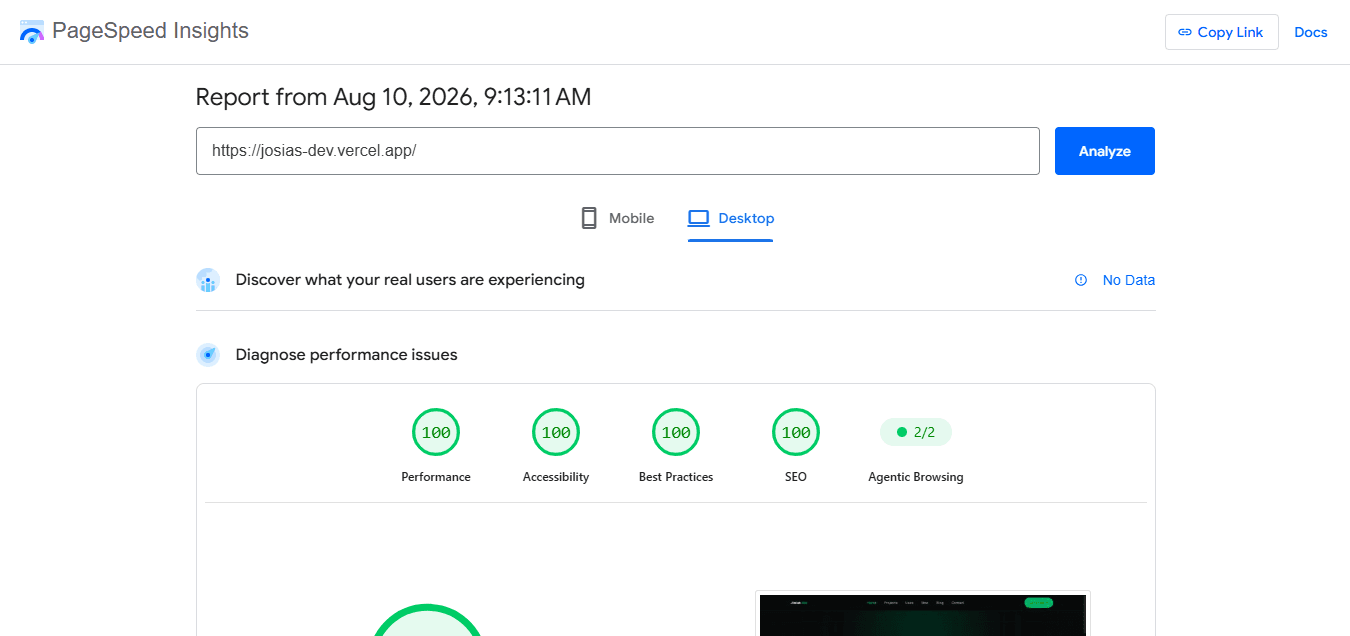
I ran this site through PageSpeed Insights after shipping the redesign, mostly out of habit. The result: 100 on Performance, 100 on Accessibility, 100 on Best Practices, 100 on SEO — and a 2/2 on the newer "Agentic Browsing" check, which scores how well a page holds up when an AI agent is the one reading and navigating it, not a human.
None of that happened by accident, and none of it happened because I'm an exceptional developer. It happened because building with AI today means the boring, easy-to-skip work — semantic HTML, alt text, lazy loading, correct heading structure, a sitemap, a robots.txt, Server Components by default — stops being the part you cut corners on when you're tired at 11pm. It's just part of the build, every time, because it's cheap to get right from the start.
What actually changed
A few years ago, a perfect Lighthouse score was a project on its own — an afternoon of profiling, image compression passes, a second look at your bundle. Today it's closer to a default outcome of following good practice from the first commit: static generation where it makes sense, images through next/image, fonts self-hosted instead of round-tripping to Google, metadata written per page instead of bolted on at the end.
The interesting part isn't that a score hit 100. It's that hitting 100 barely required deciding to.
What it doesn't mean
A perfect score is not a finished product. It says nothing about whether the copy is honest, whether the design has a point of view, or whether anyone actually wants to use what's been built. Those are still entirely human calls — what to build, for whom, and why it matters — and no score measures them.
If anything, that's the shift worth naming: the mechanical craft of shipping a fast, accessible, well-structured site is becoming table stakes rather than a differentiator. What's left to differentiate on is judgment — the product decisions, the taste, the restraint to leave things out. That part hasn't gotten any easier, and I don't think it will.
Where this leaves builders
I'm not interested in the framing where AI replaces the work of building products. What I've found instead is that it removes the tax on doing things properly — the parts of the job that were always "correct" to do but easy to defer. That tax used to buy you an excuse. It doesn't anymore.
This site — the one you're reading this on — is the proof I have on hand today. I'll keep updating this post as that bar keeps moving.